
Short Description: Discover how a Fluidized Bed Separator improves particle classification in dry jet milling. Learn about its working principles, key advantages, and applications in ultrafine powder processing.
Understanding the Fluidized Bed Separator in Dry Grinding
In modern powder processing, achieving precise particle sizes while maintaining product purity is a major challenge. Industries such as pharmaceuticals, fine chemicals, agrochemicals, and advanced materials require efficient dry grinding technologies to meet increasingly demanding production standards.
A Fluidized Bed Separator plays an important role in this process by helping separate fine particles from oversized materials according to their particle size. When integrated into a fluidized-bed jet milling system, it supports continuous grinding, accurate classification, and consistent powder quality.
Unlike conventional mechanical grinding equipment, dry jet milling uses high-speed compressed air to accelerate particles. The particles collide with each other inside the grinding chamber, generating impact forces that reduce their size without relying on mechanical grinding media.
How Does a Fluidized Bed Separator Work?
In a fluidized-bed jet mill, raw materials enter the grinding chamber through a controlled feeding system. High-speed airflow accelerates the particles, causing repeated collisions and producing ultrafine powders.
After grinding, the Fluidized Bed Separator works with the internal air classification mechanism to control particle separation.
The classification process generally involves three stages:
1. Particle Acceleration and Grinding
Compressed air enters through specially designed nozzles, creating high-velocity airflow. Raw material particles collide with one another and gradually become finer.
2. Particle Size Classification
The classification wheel generates a centrifugal force that works against the inward airflow. Fine particles meeting the required size specifications can pass through the classification area, while oversized particles are retained for further grinding.
3. Product Collection
Qualified fine powder moves with the airflow into the collection system, typically including a cyclone separator and bag filter. This integrated process helps maintain continuous production and reduce material loss.
Key Advantages of Fluidized Bed Separation in Jet Milling
Choosing the right Fluidized Bed Separator configuration can significantly influence dry grinding performance.
- Precise Particle Size Control: Adjustable classifier speed allows manufacturers to regulate the separation point and achieve different particle size requirements.
- Improved Product Consistency: Continuous classification helps reduce oversized particles and maintain a more controlled particle size distribution.
- Reduced Contamination Risk: Airflow-based grinding minimizes direct contact with mechanical grinding components, supporting high-purity powder production.
- Suitable for Heat-Sensitive Materials: The expansion of compressed gas creates a cooling effect, making jet milling suitable for many temperature-sensitive materials.
- Continuous Processing: The circulation of oversized particles supports stable grinding operations and efficient material utilization.
Applications in Different Industries
A modern Fluidized Bed Separator integrated into a dry jet milling system can support various industrial applications.
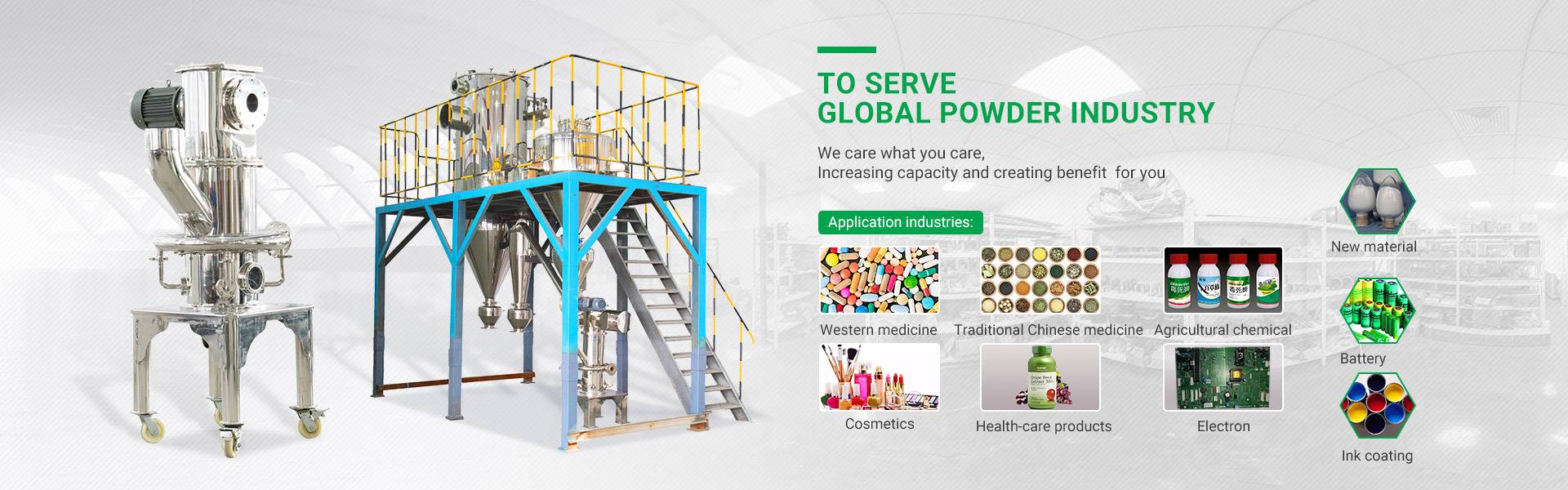
In pharmaceutical manufacturing, precise particle classification helps meet specific powder fineness and quality requirements. In agrochemical production, it supports the processing of pesticide powders and water-dispersible granules. For battery materials, ceramics, and specialty chemicals, controlled particle size distribution is essential for downstream processing and final product performance.
However, equipment selection should always consider material hardness, moisture content, target particle size, production capacity, and contamination requirements.
How to Choose the Right Dry Jet Milling Equipment
Before selecting a Fluidized Bed Separator or complete jet milling system, manufacturers should evaluate several important factors:
- Required particle size range and distribution.
- Material characteristics and grinding difficulty.
- Expected production capacity.
- Classification accuracy and adjustment flexibility.
- Dust collection and environmental protection requirements.
- Safety standards for flammable or explosive materials.
An integrated system combining a jet mill, classifier, cyclone separator, and dust collector can provide a more coordinated solution than selecting individual components independently.
Partner with Qiangdi for Advanced Dry Grinding Solutions
Kunshan Qiangdi Grinding Equipment Co., Ltd. specializes in the development and manufacturing of high-end powder processing equipment. Its product range includes fluidized-bed jet mills, disc-type supersonic jet mills, air classifiers, GMP/FDA-compliant grinding systems, and intelligent explosion-proof pulverizing solutions.
With a focus on equipment innovation and practical industrial applications, Qiangdi provides customized dry grinding solutions for different material processing requirements.
Whether you need a precision Fluidized Bed Separator or a complete ultrafine jet milling production line, choosing an experienced equipment manufacturer can help improve production efficiency, powder consistency, and long-term operational reliability.
Contact Qiangdi to explore suitable dry jet milling solutions for your powder processing needs.
Post time: Nov-10-2026